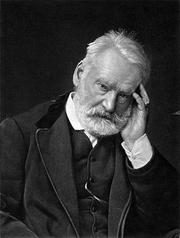
26 February 1802 – 22 May 1885
Victor-Marie Hugo was a French poet, playwright, novelist, essayist, visual artist, statesman, human rights activist and exponent of the Romantic movement in France. In France, Hugo's literary fame comes first from his poetry but also rests upon his novels and his dramatic achievements. Among many volumes of poetry, Les Contemplations and La Légende des siècles stand particularly high in critical esteem, and Hugo is sometimes identified as the greatest French poet. Outside France, his best-known works are the novels Les Misérables and Notre-Dame de Paris (known in English also as The Hunchback of Notre-Dame). Though a committed conservative royalist when he was young, Hugo grew more liberal as the decades passed; he became a passionate supporter of republicanism, and his work touches upon most of the political and social issues and artistic trends of his time. He is buried in the Panthéon. ([Source][1]) [1]: http://en.wikipedia.org/wiki/Victor_Hugo
Les Misérables
1862
Notre Dame de Paris
1831
Prentice Hall Literature--World Masterpieces
1991
Quatrevingt-treize
1800
Sefiller
2000
L'homme qui rit
1800
Travailleurs de la mer
1800
Os miseráveis
2007
Hernani
1830
The last day of a condemned man
1992
Poems
1897
La légende des siècles
1800
Le dernier jour d'un condamné
2006
Les contemplations
1856
Ruy Blas
1838
Le Rhin
1800
Nuestra Senora de Paris
1994
Notre-Dame de Paris. 1482
1832
Hunchback of Notre-Dame
1995
Les Contemplations*
1993
Lucrèce Borgia
1830