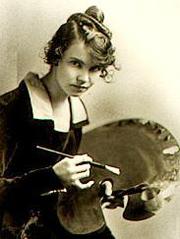
11 March 1893 – 27 June 1946
Wanda Hazel Gág was born in New Ulm, Minnesota, the daughter of a painter and photographer. Her parents spoke German in the house and Wanda did not learn to speak English until she went to school. When she was 14 years old, her father died of tuberculosis, and since her mother was also ill, Wanda became the head of the household. She stayed in school until her high school graduation in 1912. She worked as a teacher for a year, and supplemented her work with writing and illustrating for magazines, designing greeting cards and calendars, and painting lampshades. She received a scholarship to study art in St. Paul, and then moved to New York City. She continued to support her six younger siblings. In 1917 she illustrated A Child’s Book of Folk-Lore. In 1923, following a successful exhibition in New York, she left her job and began spending her summers in a country house in Connecticut and later on a farm in New Jersey. She drew and painted during the summer, then worked in New York engaged during the winter. At the time she was known for her lithographs, although today she is better known for her children's books, especially Millions of Cats (1928), for which she received the Newbery Honor Award. Wanda died of lung cancer in 1946 at her home in New Jersey.
Millions of cats
1928
The ABC bunny
1933
Nothing at all
1941
Folk and fairy tales
1935
Snow White and the seven dwarfs
1938
My Own Book of Animal Stories
1991
Gone is gone
1933
The Six Swans
1982
Wanda Gág's The earth gnome
1985
Growing pains
1940
The girlhood diary of Wanda Gág, 1908-1909
2000
Wanda Gág's The sorcerer's apprentice
1979
The Funny Thing
1929
More tales from Grimm
1947
Tales from Grimm
1963
Three Gay Tales from Grimm
1942
Wanda Gág's story book
1932
Snippy and Snappy
1931