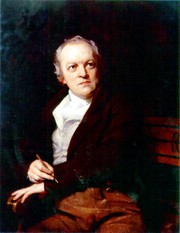
28 November 1757 – 12 August 1827
William Blake was an English poet, painter, and printmaker. Largely unrecognised during his lifetime, Blake is now considered a seminal figure in the history of both the poetry and visual arts of the Romantic Age. His prophetic poetry has been said to form "what is in proportion to its merits the least read body of poetry in the English language".[1] His visual artistry has led one British art journalist to proclaim him "far and away the greatest artist Britain has ever produced".[2] Although he only once journeyed farther than a day's walk outside London during his lifetime,[3] he produced a diverse and symbolically rich corpus, which embraced the imagination as "the body of God",[4] or "Human existence itself".[5] ([Source][1].) [1]:http://en.wikipedia.org/wiki/William_Blake
Poems
1783
The marriage of Heaven and Hell
1793
Songs of innocence and of experience
1794
Prentice Hall Literature - Timeless Voices, Timeless Themes - The British Tradition
2002
The Norton Anthology of English Literature --Seventh Edition -- Volume 2A
2000
Songs of Innocence
1789
Poetry and prose of William Blake
1927
The Classic Hundred
1990
The portable Blake
1946
Songs of experience
1794
The complete poetry and prose of William Blake
1981
The poetry of the Negro, 1746-1970
1949
Illustrations of the book of Job
1825
Prentice Hall Literature--The British Tradition
2000
Songs of Innocence and Experience
1971
First book of Urizen
1815
America, a prophecy
1793
Songs of innocence; and Songs of experience
1902
The Complete Poetry & Prose of William Blake
1997
Tiriel
1967
The Complete Poems
1978
A Treasury of Christmas Classics
1997